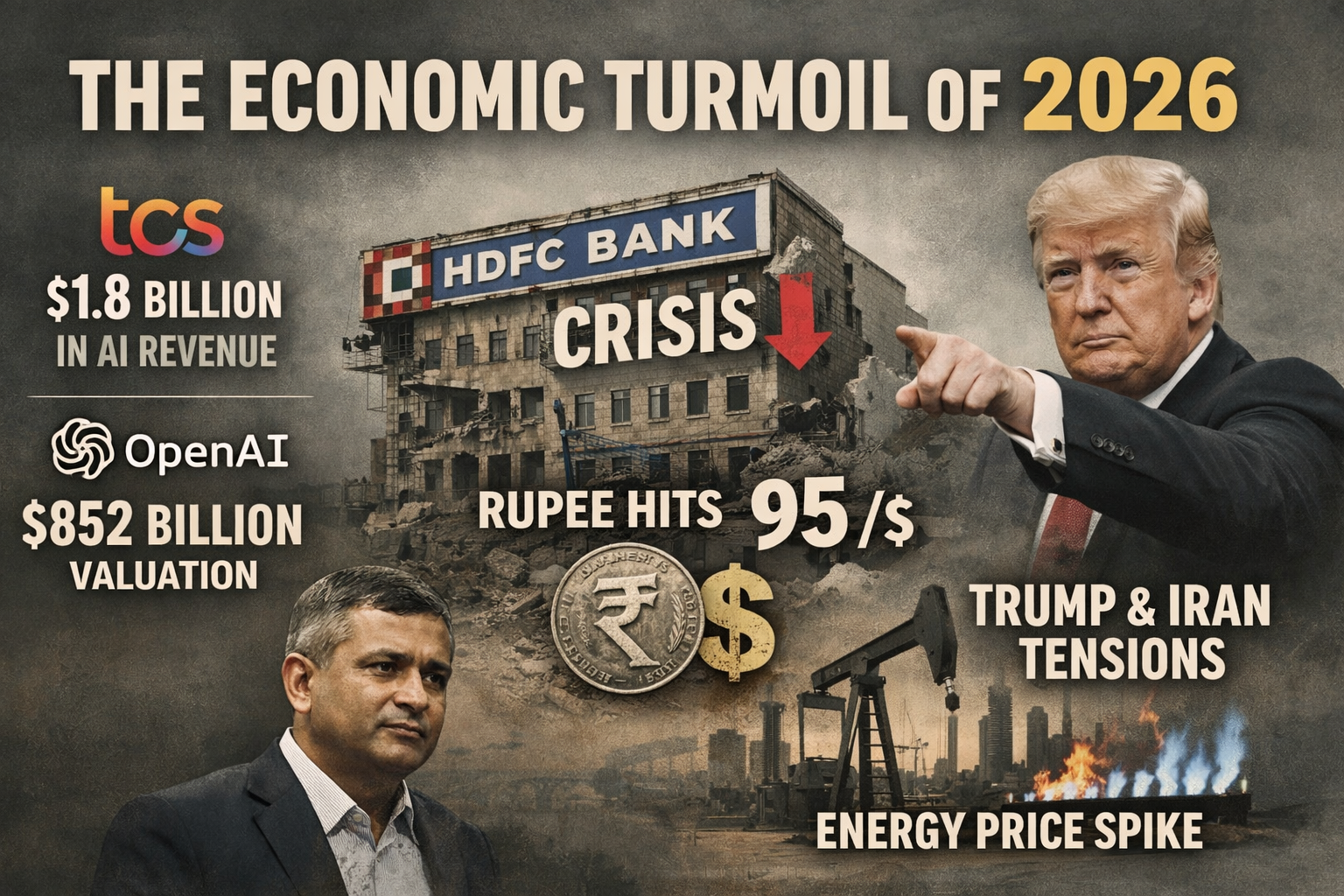
The year 2026 has emerged as a watershed moment for the global economy. It is a year defined by a paradox: while artificial intelligence (AI) is reaching unprecedented financial milestones and startups are securing record-breaking valuations, the traditional pillars of the market—currency stability, banking giants, and historical trade alliances—are facing severe tremors. From Tata Consultancy Services (TCS) crossing the billion-dollar AI threshold to the Indian Rupee breaching the 95/$ mark, the business landscape is being rewritten in real-time.
1. The AI Gold Rush: TCS and OpenAI Set the Pace
If 2023 was the year of AI curiosity, 2026 is the year of AI monetization.
TCS Hits $1.8 Billion in AI Revenue
Tata Consultancy Services (TCS) recently reported a monumental milestone, hitting $1.8 billion in annualized AI services revenue. This validation of their AI investment strategy comes even as the company optimizes its workforce, showing a net reduction of 30,000 employees over two quarters. The message is clear: the future of IT services is not in headcount, but in high-margin, intelligence-driven solutions.
OpenAI’s Astronomical Valuation
On the global stage, OpenAI continues to defy gravity. The company recently raised $122 billion at an $852 billion valuation. Backed by titans like SoftBank, Microsoft, and NVIDIA, OpenAI is now nearing a trillion-dollar valuation, signaling that the “AI Bubble” has yet to find its ceiling. Similarly, the fitness tech firm Whoop raised $575 million, reaching a $10 billion valuation, proving that AI-integrated hardware remains a top priority for venture capital.
2. Market Volatility: Sensex, Rupee, and the HDFC Crisis
Despite the tech optimism, the Indian financial markets are navigating their most challenging period in half a decade.
- The Negative Return: For the first time in six years, the Sensex is on track to post a negative annual return, falling by approximately 5%.
- HDFC Bank’s 16-Year Low: In a shocking turn for institutional investors, HDFC Bank shares have plummeted to a 16-year low. Despite buy ratings from firms like Jefferies and JPMorgan, the stock remains under intense pressure following post-merger corrections and shifting FPI sentiments.
- The 95-Rupee Mark: The Indian Rupee hit a historic low, crossing 95 per US Dollar in March 2026. While the Finance Ministry maintains that fundamentals are strong, the 10% depreciation over the fiscal year has made imports significantly more expensive.
3. Geopolitical Tensions and the Energy Crunch
The return of Donald Trump to the US Presidency has introduced a new layer of volatility into global energy and defense sectors.
The Trump Doctrine: NATO and Iran
President Trump’s recent announcements have sent shockwaves through international alliances. His “strong consideration” of exiting NATO, calling it a “paper tiger,” has forced European nations to ramp up defense spending. Simultaneously, his aggressive stance on Iran—claiming a goal to “take the oil”—has coincided with a 70% surge in European natural gas prices.
Impact on Indian Oil Marketing Companies (OMCs)
India is feeling the heat of these global tensions. Indian OMCs are reportedly losing ₹104.99 per liter on diesel at the retail level. While the government has kept prices for regular petrol and diesel unchanged to protect consumers, the commercial sector has been hit with a massive ₹195.5 hike in LPG cylinder prices, fueling concerns over domestic inflation.
4. The Startup Ecosystem: From IPO 157X Returns to “Short-Seller” Attacks
The Indian startup narrative in 2026 is one of extreme highs and cautionary tales.
The Shadowfax Success
Shadowfax’s IPO has become a legendary exit for its founders. Kunal Bahl and Rohit Kumar Bansal reportedly minted 157X returns on their early investments, showcasing the immense potential of the Indian logistics sector.
The MakeMyTrip Controversy
Conversely, the travel giant MakeMyTrip has come under fire from Morpheus Research. The short-seller published a scathing report alleging that MakeMyTrip inflated its metrics by 600% and defied CCI orders regarding price parity. This report caused a sharp dip in share prices, reminding founders that “growth at any cost” is under heavy scrutiny in 2026.
5. Global Trade and the Talent Shift
Trade dynamics are shifting as countries look beyond traditional partners to manage the fallout of the US-China trade war.
- China’s $1.2 Trillion Surplus: Despite heavy US tariffs, China reported a record trade surplus in 2025, driven by massive export growth in ASEAN and Africa.
- South Korea’s Export High: South Korea hit a 38-year export high in March 2026, primarily due to the global demand for AI-powered memory chips.
- The Harvard Decline: A notable trend in global education is the 31% drop in Indian students at Harvard University. Tightening visa curbs and shifting career priorities have led Indian talent to explore domestic or European alternatives.
6. Workforce Disruptions and Corporate Reshuffling
As AI takes over, the labor market is undergoing a painful transition.
- Oracle Layoffs: Oracle recently announced a layoff of 12,000 staff members in India as part of a global restructuring focused on AI and data center efficiency.
- TCS Rationalization: As mentioned, TCS’s workforce shrink of 30,000 highlights a broader trend where IT giants are replacing entry-level coding roles with automated AI workflows.
- UP Government’s “Puch AI” Debacle: In a high-profile move, the UP Government canceled a ₹25,000 crore MoU with “Puch AI” after due diligence revealed a lack of net worth and missing financial disclosures, serving as a warning against “hype-based” government contracts.
Frequently Asked Questions (FAQ)
Q1: Why is HDFC Bank stock falling in 2026?
HDFC Bank has touched a 16-year low primarily due to post-merger valuation corrections, sustained selling by Foreign Portfolio Investors (FPIs), and broader geopolitical tensions affecting large-cap banking valuations in India.
Q2: What is the impact of the Rupee reaching 95 per Dollar?
A weaker Rupee significantly increases the cost of crude oil imports, leading to higher logistics and fuel costs. However, it can benefit IT exporters and textile manufacturers whose earnings are in Dollars.
Q3: How much did OpenAI raise in its latest funding round?
OpenAI closed a massive $122 billion funding round at a valuation of $852 billion, making it one of the most valuable private companies in history, fueled by the demand for GPT-5 and AI chips.
Q4: Is the Indian stock market in a crash in 2026?
While not a total crash, the Sensex has posted its first negative return in six years (down ~5%). This is attributed to high interest rates, the 95/$ exchange rate, and the global energy crisis triggered by the Iran conflict.
Q5: Why did the UP Government cancel the deal with Puch AI?
The ₹25,000 crore deal was canceled after due diligence revealed that the startup, which was only a year old, lacked the financial disclosures, net worth, and credible funding sources required for a project of that scale.
Key Takeaways for 2026
- AI is the new Revenue Engine: Companies not generating direct revenue from AI are seeing valuation stagnation.
- Energy is the ultimate Variable: Geopolitical conflicts in West Asia and Europe are the primary drivers of inflation.
- Currency Pressure is Real: A 95-Rupee Dollar is changing the economics of Indian exports and imports.
- Regulatory Scrutiny is Peak: Short-sellers and government auditors are looking closer than ever at “new-age” tech metrics.