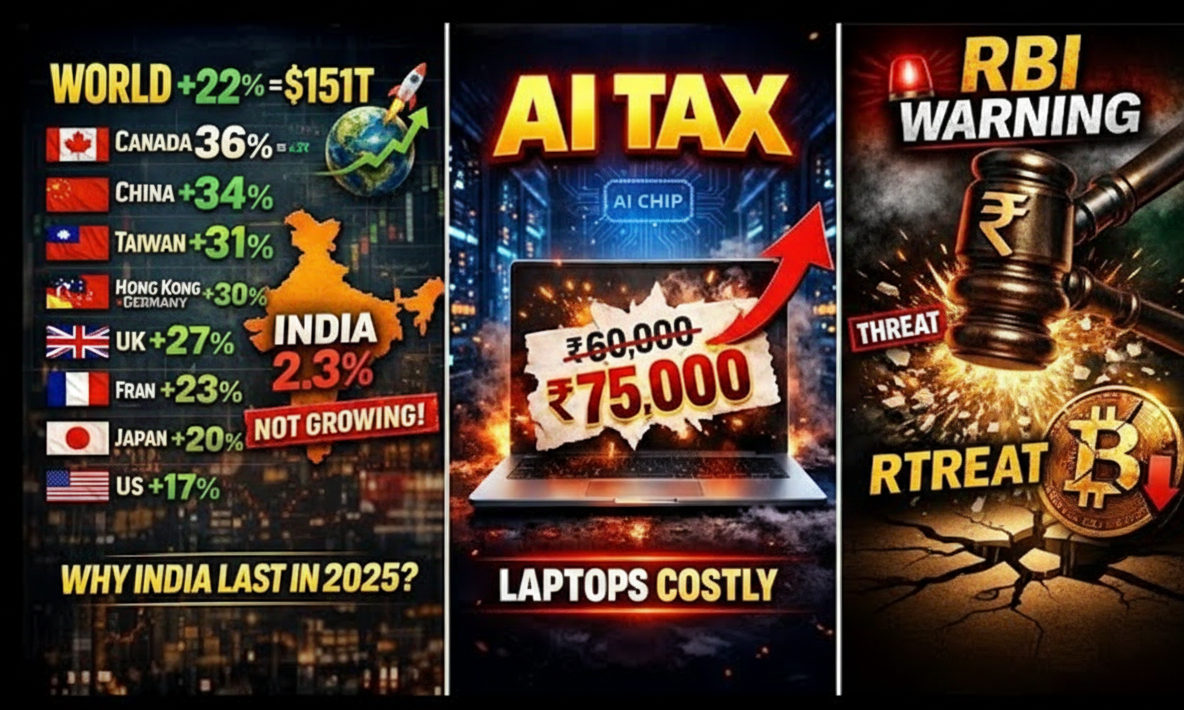
As we step into the first week of 2026, the global and Indian economic landscapes are witnessing a period of significant transition. From the cooling of the Indian stock market’s meteoric rise to a massive shift in the semiconductor industry and the evolving startup ecosystem, the beginning of the year has brought a flurry of critical updates.
1. Indian Markets: A Year of Moderate Gains and FII Retreat
The Indian equity markets closed 2025 with a mixed bag of results. While the benchmark indices stayed in the green, underlying data suggests a tightening of liquidity and a shift in investor preference.
- Nifty 50’s 10.5% Annual Return: The Nifty 50 ended 2025 with a respectable 10.5% return, outperforming several other domestic indices. However, the Nifty Next 50 saw a meager 2% growth, while the Smallcap 250 index actually dipped by 6%.
- Source: Business Line
- Slowest Market Cap Growth in 3 Years: India’s stock market capitalization grew by only 2.3% in 2025, reaching $5.27 trillion. This represents the slowest pace of growth in three years, largely due to a weakening Rupee and global economic shifts.
- Source: Business Line
- FII Holdings at a 14-Year Low: Foreign Institutional Investors (FPIs/FIIs) have reduced their equity holdings in India to 15.5%—the lowest level since 2011. FPIs withdrew nearly $18 billion (₹1.6 lakh crore) from Indian equities in 2025.
- Source: Business Line
2. Macroeconomic Pressures: Rupee and Debt
The broader Indian economy is facing headwinds from currency depreciation and rising consumer leverage.
- Rupee’s Biggest Decline: The Indian Rupee saw its most significant annual decline in three years, depreciating by 4.7% in 2025. By the end of the year, the Rupee hovered near the ₹90/$1 mark, despite aggressive interventions by the RBI.
- Source: News Bytes
- Rising Household Debt: India’s household debt has surged to 41.3% of the GDP as of March 2025, significantly higher than the five-year average of 38.3%. A staggering 55.3% of these borrowings are focused on non-housing retail loans (consumption-focused), indicating that Indians are increasingly borrowing to maintain lifestyles.
- Source: News Bytes / RBI
3. Cryptocurrency and the RBI’s Stance
The Reserve Bank of India (RBI) remains cautious regarding decentralized digital assets while pushing its own sovereign alternative.
- Stablecoins as a Threat: The RBI has explicitly labeled stablecoins as a threat to Indian sovereignty and financial stability. The central bank favors Central Bank Digital Currencies (CBDCs) over private stablecoins to maintain control over monetary policy.
- Source: News Bytes / RBI
- Bitcoin’s Annual Loss: For the first time since 2022, Bitcoin posted an annual loss in 2025. After peaking near $126,000, it corrected to approximately $87,474 by the year’s end, influenced by macro-economic shifts and a “bursting” of the AI bubble in some sectors.
- Source: Reuters
4. The Semiconductor War and Tech Price Hikes
The tech world is bracing for a “price shock” in 2026 due to supply chain shortages and high demand for AI-capable hardware.
- ByteDance’s $14 Billion Nvidia Bet: Despite US-China trade tensions, ByteDance (the parent company of TikTok) plans to spend $14 billion on Nvidia AI chips in 2026. This comes as the US recently eased some curbs on the H200 GPU.
- Source: Reuters
- Nvidia’s GPU Price Hike: Nvidia is set to hike GPU prices significantly. The upcoming RTX 5090, which was expected to launch around $2,000, is now rumored to reach a staggering $5,000 due to DRAM shortages and a 80% increase in production costs.
- Source: X (Social Media Reports)
- Consumer Tech Inflation: ASUS has announced price hikes starting January 5th, 2026, across laptops, motherboards, and monitors. Sony has also reportedly delayed the release of the PlayStation 6 (PS6) to 2027, citing memory shortages.
- Source: X (Social Media Reports)
- TSMC’s China Operations: In a surprising move, the US government has allowed TSMC to continue importing American semiconductor equipment for its Nanjing factory in China, ensuring global supply chain stability.
- Source: News Bytes
5. Corporate and Startup Updates: Vi, Traya, and Pixxel
The Indian startup and corporate sector saw significant movement in funding and financial reporting.
- Vodafone Idea (Vi) Survival Fund: Vi secured ₹5,836 crore from its promoters to handle contingent liabilities. This move is seen as a crucial step to stabilize the company’s balance sheet amidst ongoing AGR (Adjusted Gross Revenue) dues.
- Source: Economic Times (ET)
- Traya Slips into Loss: Haircare startup Traya reported a loss of ₹23 crore for FY25, despite a 43.2% increase in revenue. This highlights the high cost of brand building and customer acquisition in the D2C space.
- Source: Entrackr
- Deepinder Goyal Invests in Pixxel: Zomato’s CEO Deepinder Goyal is in advanced talks to invest approximately ₹225 crore in Pixxel, an Indian space-tech startup. This marks Goyal’s entry into the deep-tech and aerospace sector.
- Source: News Bytes
Conclusion: What to Expect in 2026?
The year 2026 begins with a cautious outlook for Indian retail investors. While the Nifty 50 remains resilient, the decline in FII holdings and the rise in household debt suggest that the market may experience volatility. Consumers should also prepare for a “tech tax,” as everything from GPUs to gaming consoles and laptops becomes more expensive due to global component shortages.
For investors, the focus should remain on high-quality companies with low debt and strong cash flows to navigate the high-interest-rate environment and currency fluctuations expected in 2026.
Keywords: Nifty 50 2025 returns, Nvidia GPU price hike, Indian Rupee depreciation 2026, Sahil Khanna LAPAAS, PS6 delay news, Indian household debt RBI, Deepinder Goyal Pixxel investment.